
Research from Nordlandsmuseet : When art tells the city's story
Marija Griniuk, Head of Department South at Nordlandsmuseet , has published a scientific article in the international journal The International Journal of the Arts in Society . The article was published on March 26, 2026 and is based on the work on the exhibition First Strike City at the City Museum in Bodø .
About the exhibition
First Strike City was created through a collaboration between the City Museum in Bodø and the British artist Dan Mariner, who lives in Bodø The exhibition was shown at the museum in the second half of 2025 and explored Bodø as a city with many layers. A place where civilian everyday life, a military base and NATO's air operations center exist side by side.
Through photography, video and soundscapes, Mariner created a space for reflection on surveillance, defense and living in a city with military infrastructure. The photographs documented the military airport in the Bodø area, an area under redevelopment where much has already been demolished. The images moved between documentation and abstraction, from panoramic views to close-ups of buildings and machinery.
Mariner deliberately chose not to use text signs in the space. Instead, sound, images and video guided the audience through the exhibition. The room was designed to give a physical sense of military zones, with camouflage colors on the walls, blocked daylight and a soundscape taken from archives and military radio communications.
-For me it was very exciting to see that the City Museum in Bodø had collaborated with Dan Mariner, and that urban history can be conveyed through art in this way. I asked Dan if it was okay with him that I analyzed the exhibition as a case for an article. He has received several versions of the article along the way, for reading and feedback, says Marija Griniuk, department head at Nordlandsmuseet and author of the article.
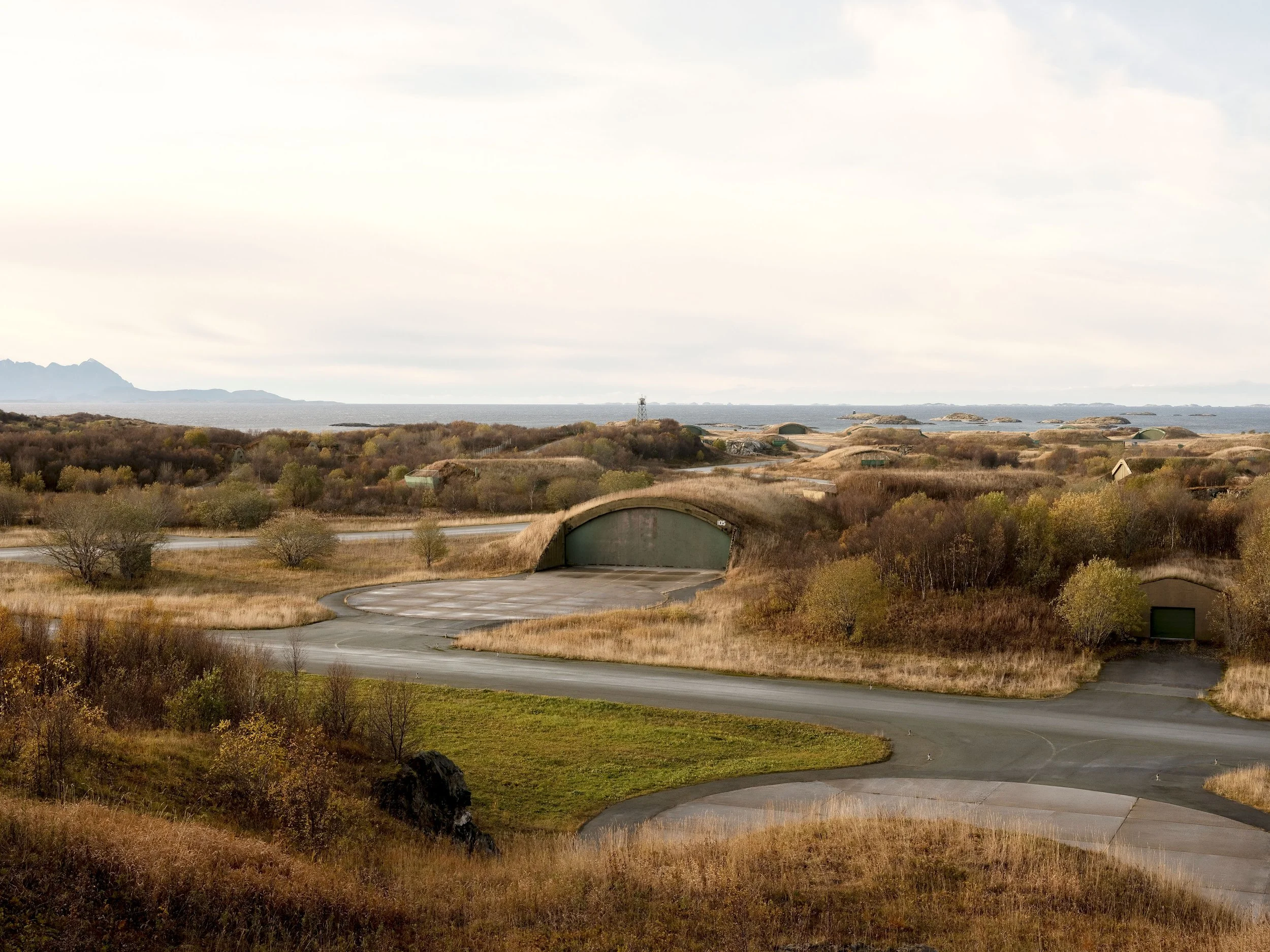
Photo: Dan Mariner
The dry aquarium
The article also discusses the dry aquarium, one of the earliest interactive installations in Norway, installed in the City Museum in Bodø after World War II. The aquarium contains plaster and dried fish, illuminated by blue light. When the audience presses a button marked with a fish name, the eyes of the corresponding fish light up. The installation is protected and cannot be physically altered.
As part of the project, Griniuk created a sound installation in the basement next to the aquarium – with sounds from the sea, waves and seagulls from the Bodø area. This is an example of how a historic and protected space can meet contemporary art without physical intervention. The sound added a new layer to the experience without disturbing the original space.

The dry aquarium is one of the earliest interactive installations in Norway, and was installed in the City Museum in Bodø after World War II.
What the research shows
The article is written based on Griniuk's own experiences from working on the exhibition, as well as notes from museum employees and feedback from the public on digital platforms such as TripAdvisor and social media.
Art as a means of communicating history works – but on different premises than traditional exhibitions. Art activates the senses and invites reflection rather than presenting facts linearly. This is a strength, but it requires the audience to be prepared for a different kind of museum experience.
The guide is crucial. This is perhaps the clearest finding. An experimental and politically charged exhibition without explanatory text can be experienced as inaccessible on its own. Feedback from the audience repeatedly showed that talking to a museum employee significantly enhanced the experience. The guide is not a support – the guide is part of the exhibition itself.
Material choice is content. The use of plastic, paint and semi-abstract photographs were not just aesthetic choices – they communicated themes such as transience, industrialization and militarization. The material spoke where the text was absent.
The collaborative process is important in itself. The fact that the exhibition was developed in dialogue between the artist and an interdisciplinary museum team, not by one curator alone, yielded a richer result and is a model worth building on.
Museums should ask themselves bigger questions. The article does not conclude with one answer, but points out that museums must actively discuss how experimental they can and should be – and what different audience groups actually expect when visiting a historical museum.
The research is an initial study and lays the foundation for further work across the Nordlandsmuseet's departments. Nordlandsmuseet has 20 facilities distributed across Salten, and the article points to the potential for investigating how art is used to communicate history in several of these.
Griniuk mentions, among other things, that they are now working with the archive of Løp farm, where the main theme is to revitalize the original recipes from Løp through experience design and performance for the audience. The results of this research will be published in May, in connection with the Design Research Society conference.
