
Stabbur at Hunstadhuset
This is a storehouse from Hernes in Bodø . Set up in Bodøsjøen in 1992.
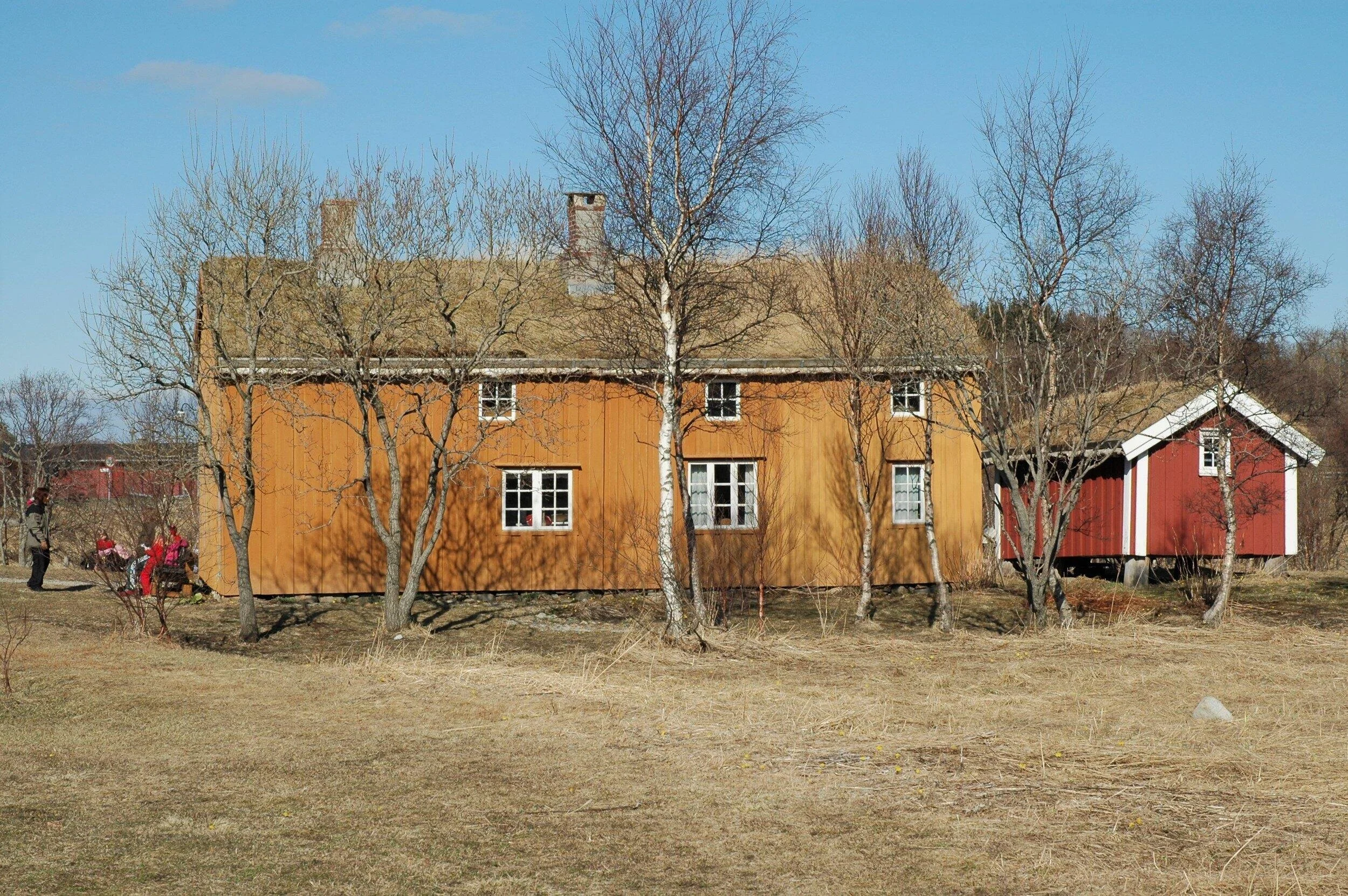
The stable was used for storing food. The word stable is believed to come from stav-bur.
On most farms, the stable was very simple, containing a single room, but on larger farms the building was often very elaborate with attics and decoration.
Inside the storehouse there were several rooms for storing different types of grain and flour. It also contained a salt barrel for salting pork. The salt barrel had to be completely tight, as the pork would eventually lie in a brine. Hooks were mounted on the ceiling for hanging smoked and salted meat products, such as cured ham. The storehouse was not frost-proof, and therefore could not store goods that would be damaged by frost. If the storehouse had two floors, grain and flour were stored on the second floor, while meat was stored on the first floor.
The building itself was placed on posts, approximately 1 – 1.5 meters above the ground. This served two purposes:
To achieve ventilation under the floor to prevent moisture from penetrating up from the ground.
To prevent mice and rats from entering the warehouse. The posts were therefore specially designed with a profile that prevented small animals from climbing up. For the same reason, there was also an opening of approx. 30 cm from the top step to the entrance.
The barn door in the farmyard was locked. The key to the barn was one of the housewife's status symbols.
Nowadays, the function as a warehouse has ceased, but due to art and tradition, many such buildings are still maintained as a storage shed. The stable is still a stately building on any farmyard today.
