
The Hunstad House in Bodøsjøen
The house was originally located in Hunstad in Bodø and is an approximately 200 year old Nordland house. The house was moved and set up in Bodøsjøen in 1992.
What is a Nordland House?
In our area we find a distinctive type of house called Nordlandhus. This type has been used for several hundred years as a residential building. Nordlandhus are quite small. They usually only have one and a half floors. The simplest versions have only three rooms; kitchen, living room and bedroom, which are located one after the other. The rooms run the entire width of the house, and have windows on two opposite walls. The second floor has exactly the same room layout as the first floor, and the attic rooms are named after the room below; the living room loft, the kitchen loft and the bedroom loft.
The room plan in the house can vary slightly; there are houses with an entrance through an annex to the kitchen and the typical hallway living rooms. The hallway living rooms are often attached, small houses. The new room was attached to the end of the two-room living room, so that the hallway that was previously at the end of the house is now in the middle. This results in rows of rooms on each side of a continuous hallway.
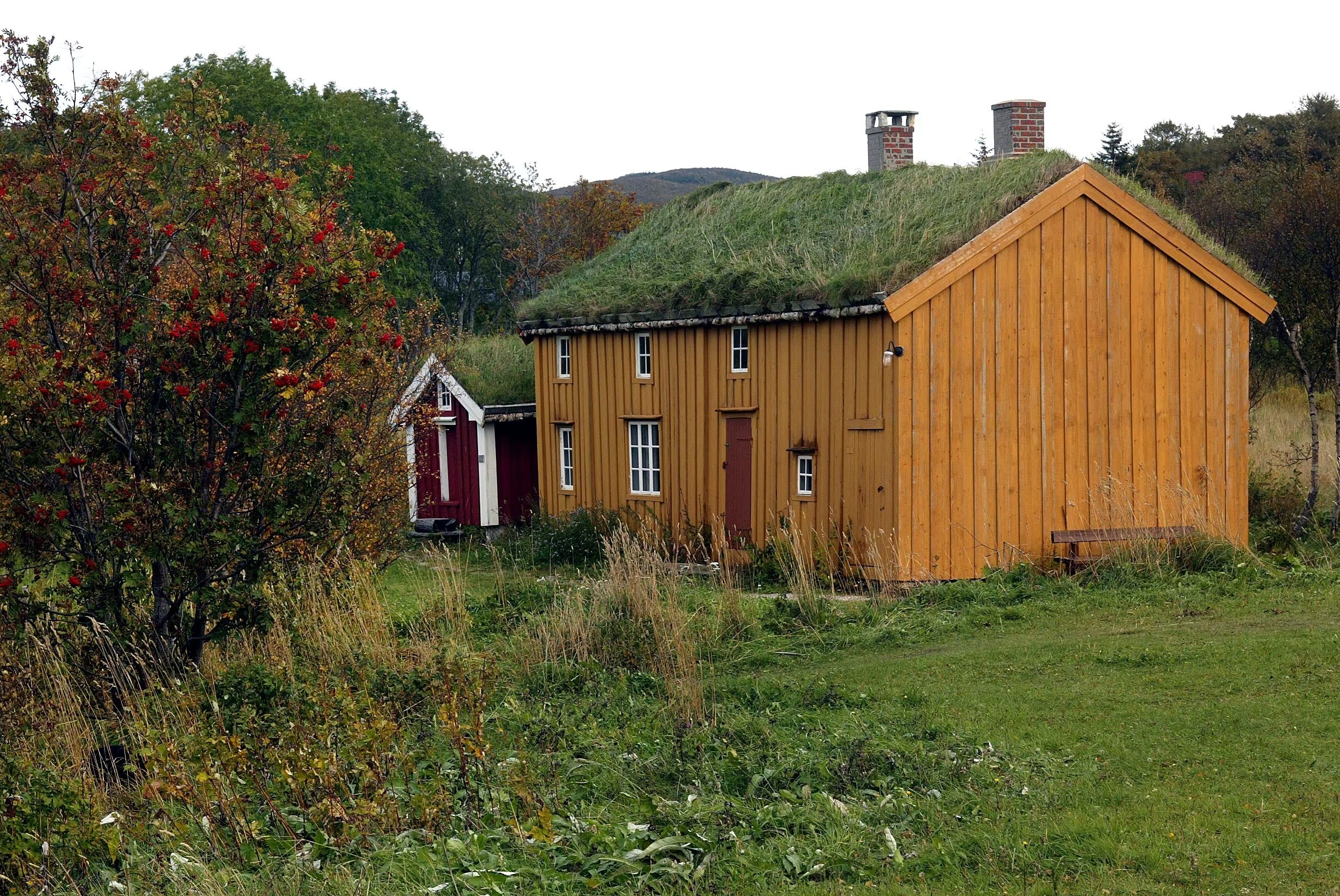
Hunstadhuset is a Nordland house
Hunstadhuset is a Nordland house. It was the main building on the Hunstad farm outside Bodø The house was first left outside in one of the barns outside Bodø and was moved to Hunstad in 1888. We don't know how old the house really is, but we assume that about two hundred years would be a fairly accurate age.
Finding Nordland houses that are several hundred years old is rare. Those that have been preserved have often stood in the inner districts. This is due to the climate and the natural conditions on the coast. In harsh weather places, the houses did not last as long as in warmer places.
Nordland houses are weather-oriented
Nordland houses are oriented according to the prevailing weather direction at the location. If the wind mostly comes from the southeast, the house is built so that one short wall faces southeast. This was done because it is easier to maintain a short wall than a long wall. It is also cheaper. We rarely find windows on the short walls, because it was difficult to get a completely tight seal around them. Leaks could damage the timber underneath. It was also common for the long side of the house to face the sea.
Description of Hunstad House
From the outside of Hunstadhuset we see the following: The house has two chimneys on the roof and a turf roof. The upper floor does not have full standing height over the entire floor area. The walls have been given carpenter's panels and small-paned windows on the long sides of the house. There is no side wall here, the entrance door with a window goes straight into the house itself. Three panel boards on the walls are higher than the other boards. The panel boards are not of the same width. The foundation is made of stone. The house is painted ochre yellow.
Before the house was built Bodøsjøen it was unpainted. The conservators also found no remains of paint outside. For maintenance reasons, they decided to paint the house. In addition, part of the old paneling was damaged and had to be replaced. If the house had not been painted, the differences in the colors of the wood would have been unsightly and the house would have looked stained and unkempt. The newer materials would also not have been able to withstand being left unprotected without paint.
When deciding on the color of the house, one had to find out what was the usual color of the houses in the Salten area among the fishing farmers. Paint was available in different colors, and at different prices. It was common to mix the paint yourself; one could make linseed oil paint, or the cheaper cod liver oil paint. Until 1826, only natural pigments (colors made from natural raw materials) were available. After this, chemically produced colors came along, and over time one had a much wider range to choose from.
This is what Hunstadhuset looks like inside
From the inside we can observe: The house has an attic. The walls are unpainted and without panels, we can see all the logs. There are three rooms here: kitchen, living room and bedroom. There are only moldings around the doors and windows. The moldings are painted. The interior is old and there are two fireplaces. In the living room there is a hanging chimney, while the chimney goes all the way down to the floor in the kitchen. A hanging chimney is only bricked down to the attic floor, the stove on the first floor is connected to this chimney via a pipe.
From the kitchen there is a staircase up to the attic. On the kitchen door on the living room side there is a colored staircase, as well as on the frames around the door. (colored staircases are found in several places) In the living room we find a cellar hatch (to a cellar that is not there today).
