
The fight against the hatpin
The hat has always been more than just a piece of clothing. Throughout history, headwear has served two roles: utility and status, and often both at once.
The work hats had a clear function: the mining helmet protected against head injuries, the woolen hat against the cold, the wide brim against sun and rain, the southwest against sea spray. The chef's hat and nurse's cap kept the hair away from food and patients. In professional life, headgear also became part of the uniform. The military cap, police cap, postal cap and driver's cap told those around you who you were and what you worked with.
Headgear has also signaled belonging, religious, cultural and social. Hijab, turban and skullcap show religious identity. Bunad hat, Tyrolean hat and Sami hat tell about cultural background. The hat has never just sat on the head. It has always told a story.
Over time, the hat also became a status symbol. Made of beaver felt, rabbit felt and silk, adorned with ostrich feathers, flowers and expensive hat pins, the hat became an expensive investment reserved for the wealthy. The bigger and more flashy, the clearer the message of wealth and rank.
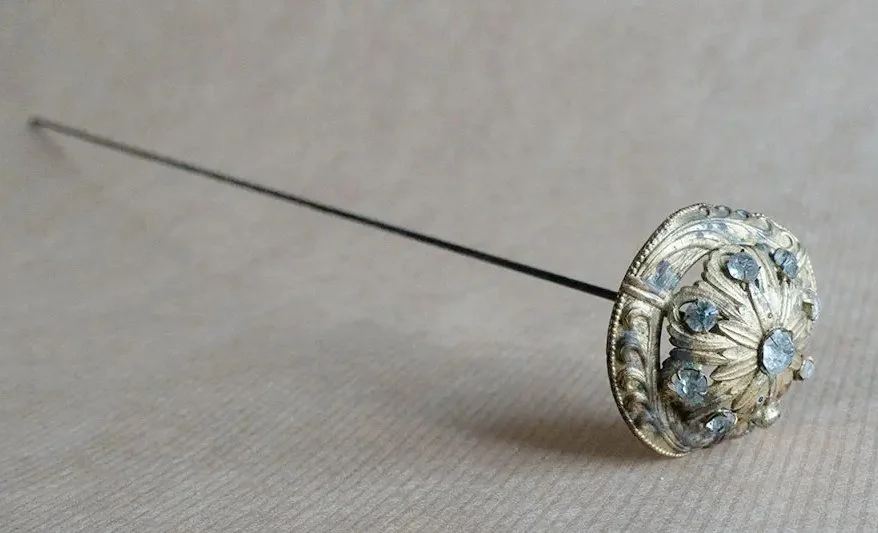
The head of the hat pin is almost shaped like a small hat, with floral motifs in bronze and small cut glass stones.
A needle that created chaos
And it was precisely the hatpins that ultimately caused problems. Large, pointed and deadly, hatpins were in practice open stab weapons in public spaces. The newspapers were full of stories about people being stabbed in the face, and in the worst case, in the eye. A man in England went blind after an unpleasant encounter with a hatpin and was awarded 400 pounds in compensation. From Trondheim, Aftenposten's correspondent reported that a man was stabbed in the eye when a young lady on the tram nodded to an acquaintance. From Berlin came the news of a conductor who was stabbed so seriously in the arm that it ended in blood poisoning and amputation.
For some women, the hatpin served a dual purpose. It held the hat in place, but it was also an excellent self-defense weapon. Long, pointed, and deadly. In the United States, authorities were so concerned that suffragettes would use them against the police that in 1908 they introduced a maximum size of nine inches. Crime writers also discovered the dramatic potential of the hatpin. Agatha Christie had a literary character die from a hatpin as late as 1928, although at a time when pins were largely out of use.
The ban that caused a stir
On June 4, 1913, the council of Kristiania adopted new rules for the tram companies: ladies with unprotected hatpins were to be expelled from the trams. Under the then Penal Code, Section 339, the most recalcitrant could be punished with fines.
There was a lot of noise. Morgenbladet dramatically reported from the city's trams: "How enraged they became, many of the lovable Beings, when the Conductor had to deny them access to the Car!" But most people were satisfied. "The other passengers saw with undivided satisfaction how excellently the Conductor performed his duties as the benevolent Public Protector. Almost at every holding area there were women carrying spears, who with usual impudence wanted to force their way in, but at the door they were met with the order of horror: - No, you are not allowed to join!
To alleviate the situation, the tram companies were ordered to sell hat pin protectors for five øre each. Sales were brisk. Kristiania Sporveisselskab sold 15,000 protectors in three days. The other company had to postpone the ban for fourteen days because there was not a single hat pin protector left in the capital. Aftenposten reported that a telegram had been sent abroad for a new supply.
The ban nevertheless proved difficult to enforce. In June 1916, a journalist reported a conductor to the police for not reacting to illegal hatpin use. Another conductor was charged with allowing two women with unprotected hatpins to ride between Frogner and Jernbanetorget. After the conductor was acquitted in 1917, the police wanted to appeal the case, but the state attorney found the grounds too weak.
Fashion saved the lawyers
The question of a general ban on hatpins on the streets and in gatherings came up again in 1914, but some things changed faster than the regulations. Since the outbreak of the First World War, the use of hatpins had been on the decline. Precious metal had found other uses. And then came the new hat fashion. Magnificent fruit basket hats and long hatpins were out. Bob hairstyles and simple bell hats were in. The poor lawyers who might have been formulating new rules were saved by fashion.
Throughout the first half of the 20th century, hats became commonplace. Simpler materials and cheaper production meant that everyone could afford them. Going bareheaded was considered strange, for both women and men. But when cars became commonplace in the post-war era, hats went out of fashion. Driving and wearing hats is simply impractical.
Today, hats are reserved for parties and holidays, and a fine summer day can bring the summer hat down from the shelf. But the story of the hatpin reminds us that even the most everyday garment can become a social problem, create legal disputes and fill the columns of newspapers for years.
