
Sami drum from Bjørsvik
The Nordlandsmuseet's collection contains a Sami drum from Bjørsvik in Nordfold in Steigen The object entered the museum's collection in 1976. There are few known drums from Nordland. What we know about this drum is based on information about where and when it was found, examinations of the wood and sources about the history of the area.
The Sami drum is a northern type of shaman drum. It is made of animal skin, most often reindeer skin, stretched over an oval frame of wood or wood. The skin is decorated with symbols, and each drum has its own, unique expression. Drums were used in Sami religious practice until Christianization in the 17th and 18th centuries, when the use of drums was prohibited. Many drums were taken from their owners or destroyed. Therefore, very few are preserved today. Of those that are preserved, most ended up in museum collections in Denmark and Germany after the confiscation. For several of them, we also do not know for sure where they were used or who owned them. For several years, work has been underway to return Sami drums to Sami areas. The drums have had a central position in Sami religious practice before Christianization, and are significant Sami cultural relics.
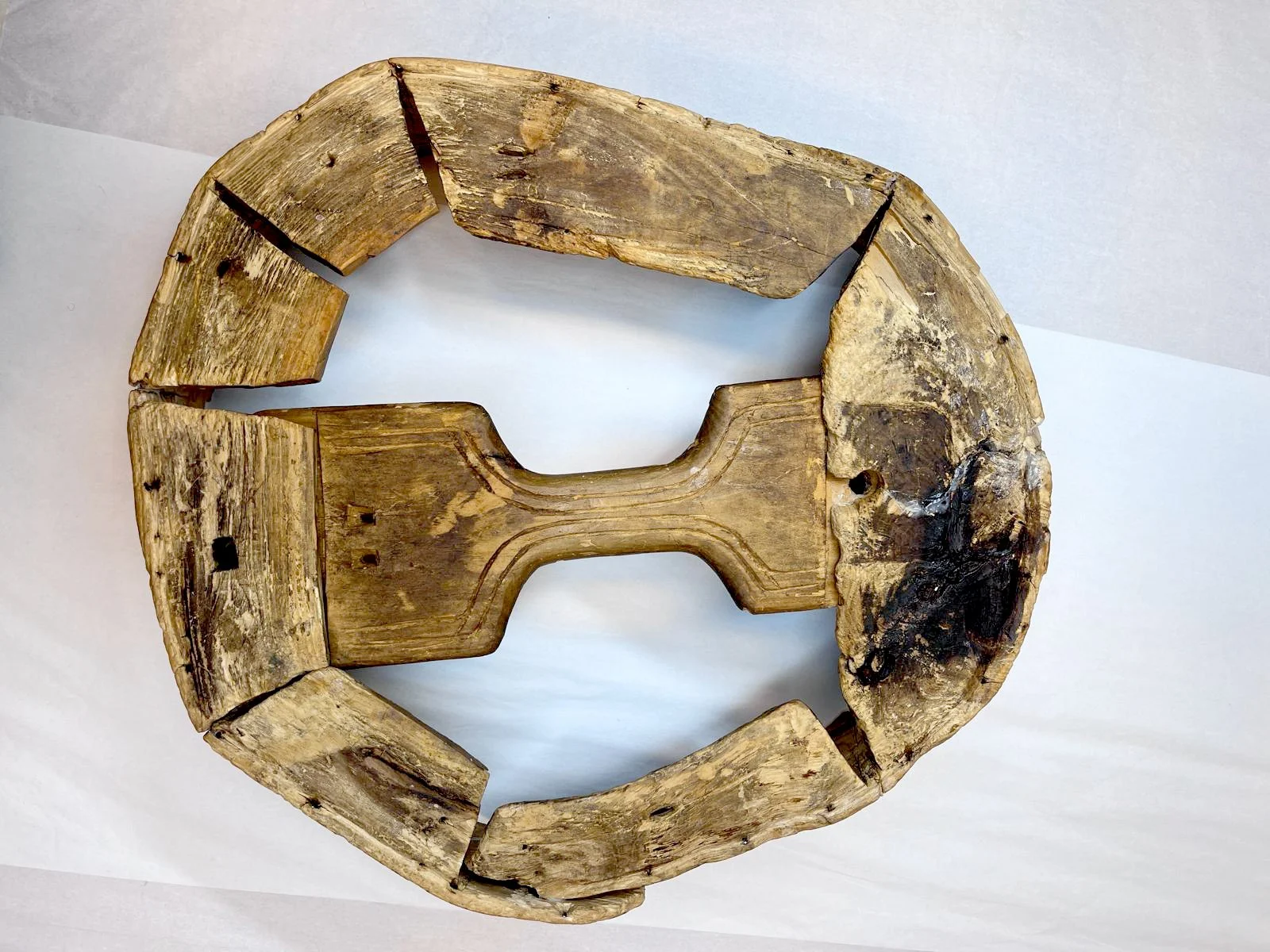
Wooden frame for a Sami drum from Bjørsvik in Nordfold in Steigen .
Found in Bjørsvik
The drum in our collection was donated to Nordland County Museum in 1976 by Elsa Bjørsvik. She stated that the object had been found by her husband, Per Bjørsvik, in the 1950s. The discovery was made in the Bjørsvik area, but the exact location is not known. Two places are pointed out as possible discovery sites: Tomashelleren and the area at Kirksteinen. Both are located in the outback and are known from other historical records.
The drum consists of a wooden frame with a handle. The wood has been identified as pine. The frame is made of a piece of wood that has been cut at an angle and swept together. This is called an angle frame drum, and is a type of drum that only exists in two other known examples, both from the Kemi Sami area in Finnish Lapland. The other known Norwegian drums are either bowl drums, which are common in Lule Sami areas, and frame drums, which are common in Southern Sami areas. The drum from Bjørsvik stands out in a Norwegian context.
Radiological dating of the wood gives an age of around 1500, with an uncertainty of a few decades. The dating corresponds to the period before the ban on the Sami religion.
The drumhead has not been preserved. Therefore, there are no painted figures or symbols associated with this specimen.
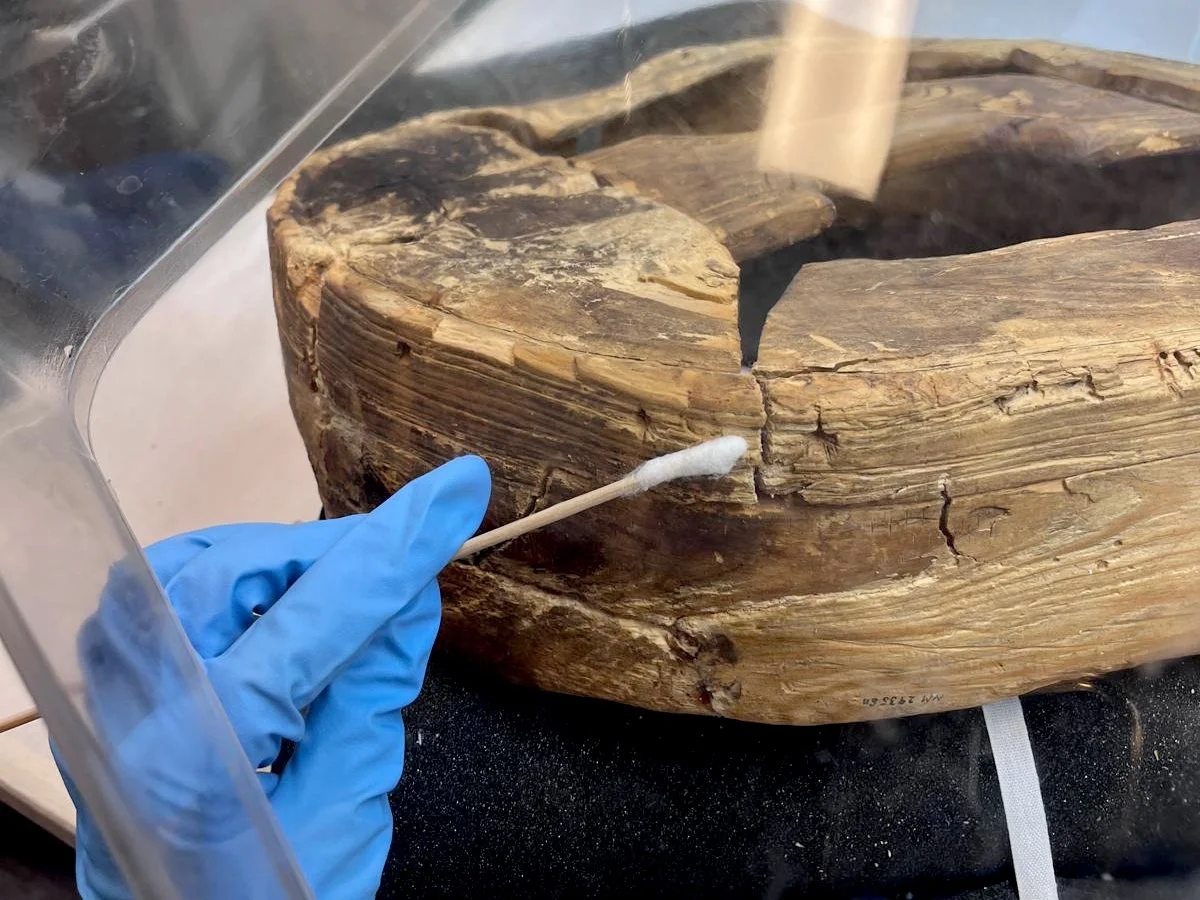
Detail from the conservation work: the wooden frame of the drum being cleaned by our conservator.
Kirksteinen and Sami traces in the landscape
At Kirksteinen there is a cave where bone accumulations in several layers have been found. Investigations in the 1970s and 1980s show findings of bones from reindeer, sheep or goat, cattle and dog. Several of the bones are marrow split, meaning they have been broken open to extract the marrow.
The composition of the bone material, the way the bones are laid out, and the lack of traces of daily occupation have led to the site being interpreted as a Sami sacrificial site. Such sites are known from Sami areas in Norway and Sweden, and they are often associated with clear natural formations such as rocks, mountains, urn, or rather. The Kirksteinen is one such natural formation, which towers over the landscape and is located in a urn. During fieldwork in the summer of 2025, researchers from Arran and Nordlandsmuseet Kirksteinen in Bjørsvik. A report from the fieldwork will be published in the spring of 2026.
Historical sources show that Sami people have lived in the Bjørsvik area from the 17th century onwards. The area was part of a Sami area of use, with reindeer herding, fishing and residence at different times of the year. Later sources show that there were also permanent Sami people living in the area, including as fisher-farmers. Over time, the Sami language and religion became less visible in the area, partly as a result of missions and Norwegianization policies.
The drum from Bjørsvik can be understood in the context of Sami activity in the area and with registered cult sites in the landscape. Although the site of discovery has not been finally clarified, the combination of the object, the dating and knowledge of the area makes an important contribution to knowledge of Sami history in Salten.
Source: Sæther, Ola (1982–83). Runebomma from Bjørsvik, Nordfold in Steigen . Nordland County Museum's yearbook.