The Eight-ringed Aust

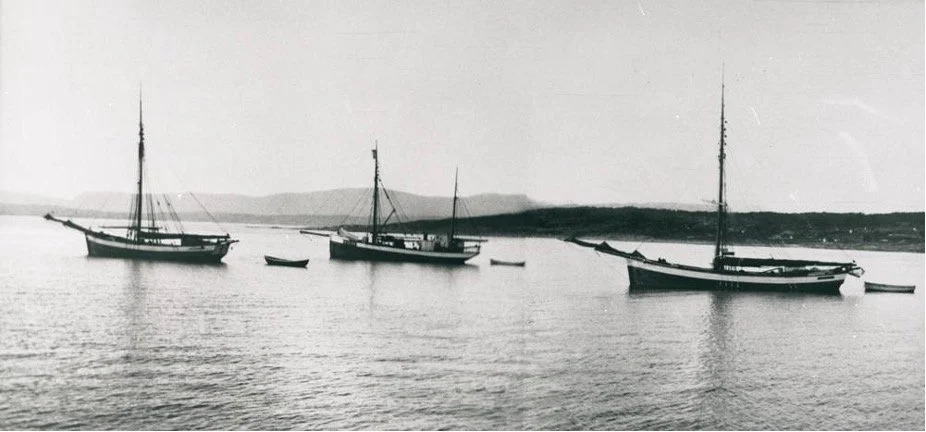
From Skålbones in Bodø. Storage space for a boat. From the late 19th century. Set up in Bodøsjøen in 1965.

Nordland boats

Of the traditional open utility boats for freight, guiding and fishing, the Nordlandsbåten has the largest geographical distribution. The boats were built and used from Bindal in the south to the Russian border in the east.

During the first half of the 19th century, the Nordland boat changed its appearance. Until about 1840, the Nordland boats had a curved (curved) bow, and were therefore nicknamed "krumstevning". The bow was straighter, and the Nordland boats looked more like the traditional open boats from Western Norway and Trønderlag. The krumstevnings had jibs as oars.

The "neoclassical" Nordland boat is recognizable by the high bow that is almost perpendicular to the keel, a marked rise towards the bow, marked by the lyre oars and the rip board, and a long, light and slender hull. The boat now has rips and toll lanes with toll sticks for the oars.

The Nordland boats are clinker-built, and were designed for propulsion with both oars and mainsails. The boat type was built in large quantities, in almost every place where there was forest for it. We know that Saltdal , Rana, Vefsn and Bindal were among the largest construction sites in the last century. In Salten, the boats were built of pine, while spruce was most commonly used in Bindal and Rana.

Towards the end of the 19th century, other types of boats were used in the fisheries, both open boats and boats with decks, and the traditional Nordland boats almost completely disappeared. The new types were often finned boats and lister boats. The smaller sizes of the "classic" Nordland boat were largely replaced by pointed boats, Ranaspiss and Saldalspisse.

The Fembøringen is the largest Nordland boat and has six, seven or more pairs of oars, depending on the size. The Fembøringen ranged in size from 38 – 50 feet.

The various Nordland boats were divided into size classes according to the number of compartments in the boat between the tofts, in addition to the number of pairs of oars. A compartment is the distance between the bands in the boat that have tofts or beets (fixed tofts of roots). The names of the compartments in a five-row rowing boat can be:

Forward bulkhead, 1: bulkhead room, 2: foreroom, 3: foresail, 4-5: aftersail (stone room), 6: afterroom, 7: afterroom (captain's room), after bulkhead.
(The forward and aft bulkheads are not considered rooms)

Nordland boats in sizes

  • Ferries, 2 pairs of oars, 2 rooms, 15 – 16 feet

  • Hundred-room scull, 2 pairs of oars, 2 1/2 rooms, 17 – 19 feet

  • Six-ring, 3 pairs of oars, 3 compartments, 19 – 21 feet

  • Half-quarter escape, 3 pairs of oars, 3 1/2 rooms, 22 – 23 feet

  • Four-rower, 4 pairs of oars, 4 compartments, 24 – 26 feet

  • Half-five escape, 4 pairs of oars, 4 1/2 rooms, 28 feet

  • Krumstevningsåtring, 4 pairs of oars, 4 rooms, 28 feet

  • Small Eight-Oared Boat, 5 pairs of oars, Neoclassical, 29 – 30 feet (“Summer Eight-Oared Boat”)

  • Large Eight, 5 pairs of oars, 5 rooms, 30 – 36 feet

  • Five-oar, 5 or 6 pairs of oars, 38 -45 feet (14.5 m)

  • Large-five bore, extra large five bore, 45 – 50 feet


Faroese and "huinnroms-Faroese" also went by the name " keks " north of Saltfjellet. The name possibly comes from a Sami term for boats of this size; keaksa . (Check with Arran) if they were particularly well equipped. The largest Nordland boats eventually got a small cabin aft for shelter for the crew, a lifting. A covered half-deck at the front also occurs occasionally.

Towards the end of the 19th century, the Nordlandsbåten was gradually outcompeted by newer boat types, and almost completely disappeared from history.

From 1970 onwards, more and more people have opened their eyes to these boats again, especially for recreational use. This has meant that many boats have been saved from decay and the Jonsock fire, and have had a new spring as restored recreational boats. Boat building has also picked up somewhat again, and there are now several active and very competent boat builders in operation. Thanks to the Nordlandsbåten, the tradition of rough sailing has survived uninterrupted. Further south in Norway, the old words and expressions associated with rough sailing fell out of use, while they barely survived among fishermen in Northern Norway. Among other things, the war forced some fishermen to return to sailboats during this period, and thus expressions and methods survived.

Many of the expressions that are now being revived among rough sailing enthusiasts in southern Norway, Sweden and Denmark are largely based on expressions that were used in the north from ancient times. When this thin remnant of tradition actually exists, it is better to keep it than to invent our own expressions. In this way, all rough sailing groups in Scandinavia today can help carry forward this part of our common Norse cultural heritage.

Previous
Previous

Gyltvik

Next
Next

Union flags