
Union flags
From "Lapland's Hell" to the cradle of the labor movement in Nordland. We tell you about the union flags at the Sulitjelma Mining Museum.
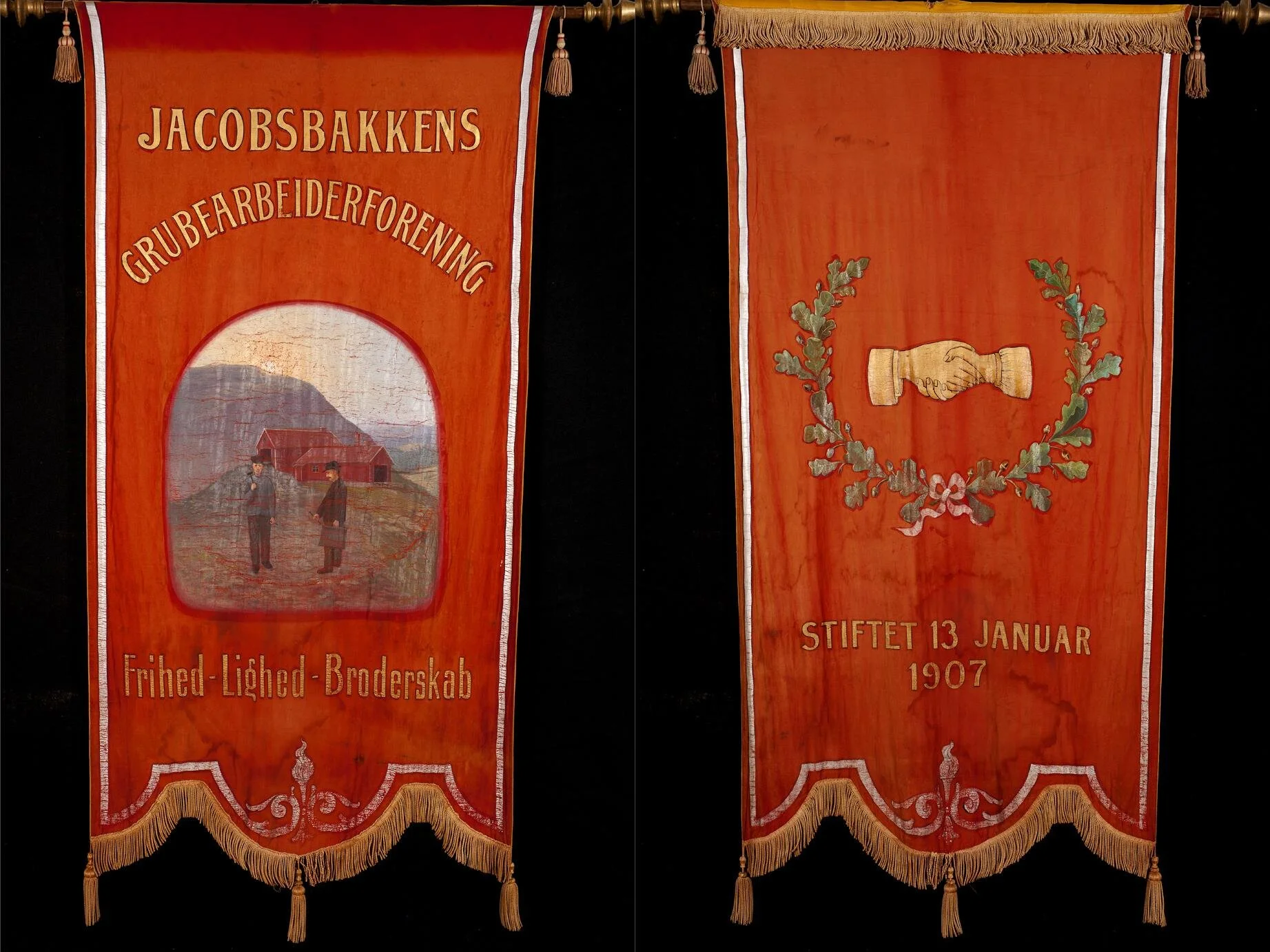
Here, the museum maintains a collection of flags, mostly union flags. The flags are designed to draw the eye towards them:
Strong colors, dominated by red, and skillfully executed illustrations of landscapes and workers in Sulitjelma surrounded by clear slogans for the various associations.
Ever since the workers' uprising in 1907, the trade union movement has been strong in Sulitjelma. Sulitjelma was previously described as a "Lapland hell" where Sulitjelma Gruber AB had all the power and owned everything, both the land and the means of transport. Agitators had previously tried to gather the workers, but were beaten out, and all attempts at union organization had been crushed by the mine management.
The background to the uprising in 1907 was, among other things, the hated "slave mark", a control mark that the management tried to introduce among the miners. Through covert channels, all the workers were informed that they should gather at Langvannsisen on January 13, 1907. Around 1,000 workers showed up and unanimously formed a trade union in Sulitjelma. The labor movement had gained ground and the management could no longer stop it.
The union was affiliated with the Norwegian Workers' Union, with 10 workers' or miners' unions at Sulitjelma Gruber. The first were Furuhaugen, Furulund, Charlotta, Sandnes, Giken, Hankabakken, Hanken, Fagerli, Jakobsbakken and Sagmo.
The union flags are today an important part of the collection that tells the story of mining, the unique community that arose around the operation and not least about the trade union movement that is still strong in today's Sulitjelma. At the same time, they are fragile objects which, in addition to their size, make them difficult to display in an exhibition.
