
The mill from Steigen
Mill from the farm Lund in Nordskott in Steigen . Given by Hans Lund, Narvik in 1937, set up in Bodøsjøen 1938.
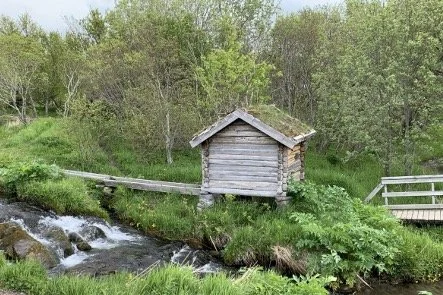
The mill was set up on the Lund farm in 1675 according to the donor. On one of the logs inside the mill is engraved the year 1775. On the funnel that led the grain from the chute under the roof to the millstone, the year 1791 is written. When the mill was moved from Steigen to Bodøsjøen , the museum has noted that the mill was built of alfiru, and that the walls were in good condition, except for the bottom wall, which was replaced during the move.
In the 19th century, mills existed on most farms in Northern Norway. They were located by rivers and streams, preferably where the water flow was good all year round. On the Lund farm, conditions were not so good; there, the stream had to be dammed up a good distance up the field to get enough water for the mill. The water from the stream was led in a channel to the mill.
The mill has two millstones, one rotating while the other is stationary. The grain is crushed between them, and a lever regulates how finely the flour is ground. A basket filled with grain hung under the ceiling, and below it a funnel suspended from a string. The funnel opens into a spout directly above the opening on the top millstone. Loosely connected to the funnel was a rod, called a shaker or shaker, which was dragged towards the rotating millstone. Our millstone has grooves carved into it, like sunbeams around the opening, to give the shaker good movement. The grooves transmitted vibrations through the shaker to the funnel, ensuring that the grain fell out of the spout in a steady flow. The flour came out at the outer edge of the two millstones, and was collected in a chute swept by fists. From there, the flour was led out into the flour box, which stood below.
In Nordland, Selbu stone and Nordland stone were used in the millstones. Millstone quarries existed in Rana, Sømna, Salten and Sørreisa. Nordland stone was also used in Bergen and the surrounding areas, they had it sent with the jects.
In this mill from Nordskott there were three carvings of jects. The jects are carved into the wood with a knife. On the bench next to the millstone itself, there is a carving of a jekt with a mainsail with four bonnets, and the wing is raised up, as they were on the old jekta. It is likely that the image of the jekta was carved in the 17th or 18th century. On a piece of fjøl that has come loose, but which also belongs to this mill, we find two more jekta images carved in.
