
Anna Elisabeth and Jens Nikolai — the people behind Kjerringøy trading post
On New Year's Eve 1822, there was a wedding on Kjerringøy. The 21-year-old Anna Elisabeth Sverdrup married Jens Nikolai Ellingsen, a young the jekt skipper from Skagstad in Steigen The guests came from all over the region, the living rooms were warm and lit, and the priest Koch from Rørstad had traveled there especially to consecrate them.
It was not just a business marriage. Contemporary sources describe them as good friends. Anna Elisabeth was already an energetic and enterprising woman who had full control over the farm and its employees.
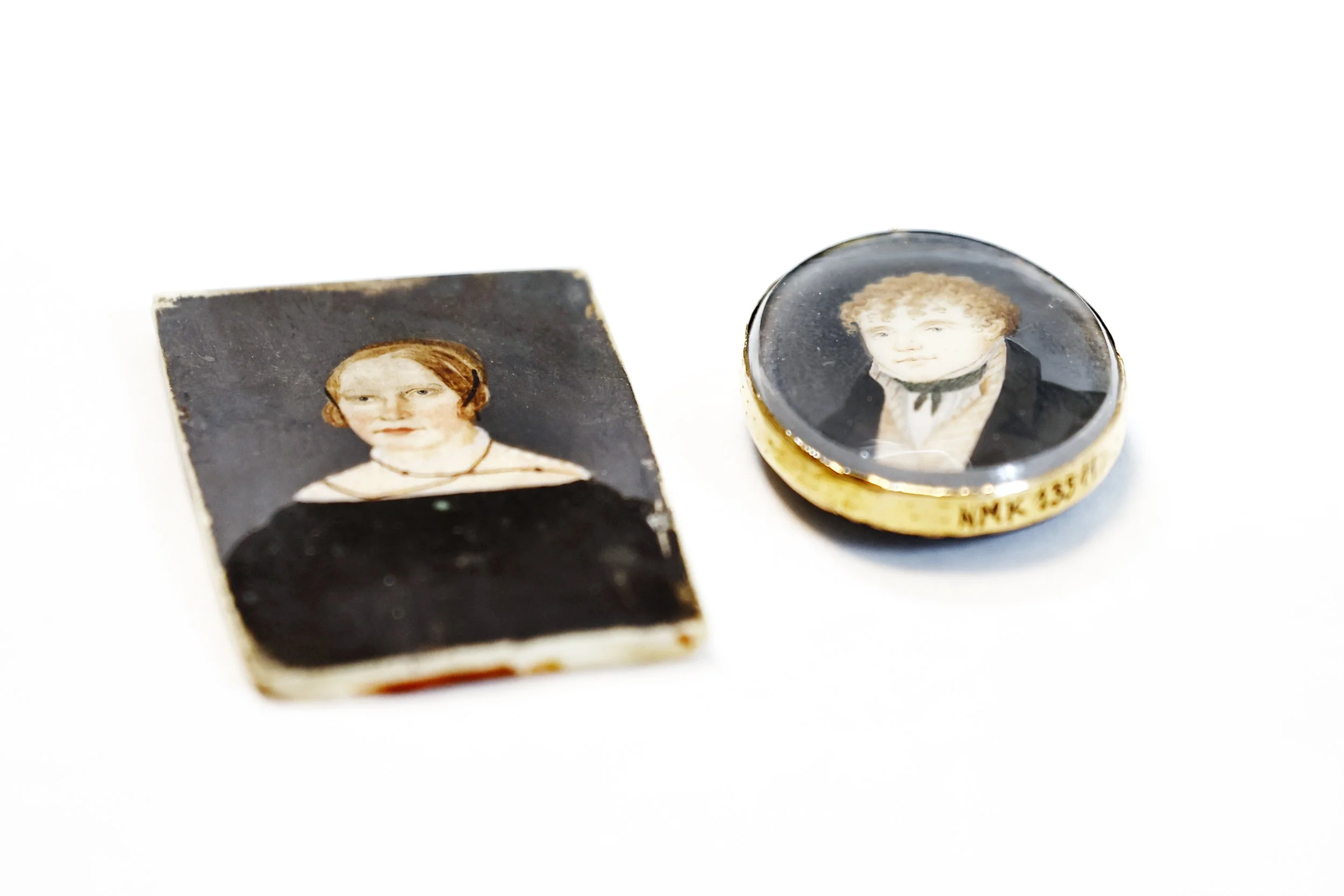
Two miniature portraits of Anna Elisabeth and Jens Nikolai. Today they are part of the collection at Kjerringøy trading post .
Anna Elisabeth Miniature portrait painted on bone plate, originally set in a wooden frame with glass and blue passepartout. The portrait has been removed from the frame.
Jens Nikolai Gold medallion with painted portrait, probably on bone plate, set in glass. The medallion has motifs on both sides – portrait on one side and dedication on the other.
The father who built Kjerringøy
Anna Elisabeth's father, Christen Sverdrup, had bought Kjerringøy in 1803. Before that, he had run a business on Hundholmen, the place that a few years later became Bodø When he sold Hundholmen, only about twenty people lived there. Kjerringøy had something Hundholmen lacked: a central location in the route for the fishing fleet to and from Lofoten, a good harbor and plenty of agricultural land.
Sverdrup immediately set about building and investing. He scaled up his farm, bought boats and increased his trade. A merchant in Bodø described him in 1809 as a rich and capable man who could procure large quantities of fish and cod liver oil. Sverdrup was also a man of importance outside of trade. He had led the defense of Folda during the war against Sweden and in 1821 was elected as a deputy to the Storting.
The three Sverdrup daughters grew up on Kjerringøy. It was said of them: the eldest was the wisest woman in Nordland, the second was the most beautiful and the third was the most talented. The wisest was Anna Elisabeth.
A powerful merchant family
Jens Nikolai came from one of Nordland's most famous merchant families. His father had grown up in Saltdalen as one of twelve siblings. All seven sons from the skipper's farm Saltnes became merchants with their own jetty and stockfish trade. When they arrived at the port of Bergen with nine or more jetties side by side, it was a demonstration of power, which could control the price they received for their goods. There were long stories about the seven Ellingsen brothers and their stockfish fleet.
Jens Nikolai had already established himself as an independent merchant when he married. He had purchased the trading post Støtt, in the middle of the channel between Helgeland and Salten, in 1825. After the wedding, the young couple ran a trade at Støtt until they took over Kjerringøy.
Takeover and growth
Christen Sverdrup died in 1829. Anna Elisabeth and Jens Nikolai took over Kjerringøy, but their mother Bolette would not let go right away. It was not until 1836 that the entire farm was transferred to them. Bolette Sverdrup moved to Bodø , obtained a trade license at the age of 68 and traded until his death in 1850.
When Anna Elisabeth and Jens Nikolai took over, they set about it with great energy. Many of the buildings we see at the trading post today were erected during their time. They bought boats, acquired more land and started several new ventures. They hired up to 90 fishermen for the Lofoten fishery, thus securing access to large quantities of raw materials. They started salting skrei for clipfish in addition to stockfish and cod production. The fish was dried on the rocks here on Kjerringøy. Jens Nikolai was eventually considered one of Nordland's richest men.
It was said of him that he was a calm and friendly man, but also far-sighted and energetic. If anyone was in need, he helped with an open hand, according to his legacy.
The son who came and went
Years passed after the wedding in 1822, without the couple having children. People in the village began to wonder. Then, in January 1838, their son Jacob was finally born. Anna Elisabeth had turned 37 years old. A full 16 years after the wedding, they finally had an heir.
Jacob was his parents' great joy from day one. His father took him everywhere, to the boathouses and piers and aboard the yachts. His mother adored him just as much. He was not only his parents' child, but the future of the entire Kjerringøy.
In the summer of 1842, Jacob went on a trip to Karlsøyvær outside Kjerringøy. On the way home, the little boy became weak and had a fever. Once home, the fever did not subside. On the 6th. July 1842 Jacob died, four years old.
Anna Elisabeth was inconsolable. It is said that she went to bed and stayed there for a whole year. Jens Nikolai took it no less hard. The grief weakened him from within, and his health never fully recovered. Seven years after his son, he died, only 53 years old, just before Christmas in 1849.
Anna Elisabeth erected gravestones for both of them. On her son's stone it read: "Below lies Jacob Christian Sverdrup Ellingsen. Born January 6, 1838. Died March 3. July 1842. May we grieving parents soon be reunited with you, never again to be separated."
On the man's stone she had had it carved: "He had the will and ability to help. The cause of the needy moved him. He was a friend of the needy."
A strong widow
As a widow, Anna Elisabeth had complete control over everything. She continued to run the trading post and proved to be just as capable as her late husband. Albeit with good help from Jens Nikolai's trading clerk. Ten years after her husband's death, she married, at the age of 58, this trading clerk, Kjerschow Zahl, who was 26 years her junior. But she never relinquished control. When guests came to Kjerringøy, she always stood one step ahead of her husband on the stairs and welcomed them with the words: "Welcome to me."
K Zahl, Kjerringø became one of Nordland's most important trading houses, and the couple gained enormous wealth. Partly because of the foundation laid by Anna Elisabeth's father and the development that came under her and Jens Nikolai. But also as a result of Zahl's good business acumen and connections, and lucky investments during a time of good times in the fish trade.
Anna Elisabeth lived most of her time on Kjerringøy. Here she became the highly respected “mother-in-law”, who had a hand in so many things, and a role in the lives of so many people. She died in 1879 and was buried next to her son.
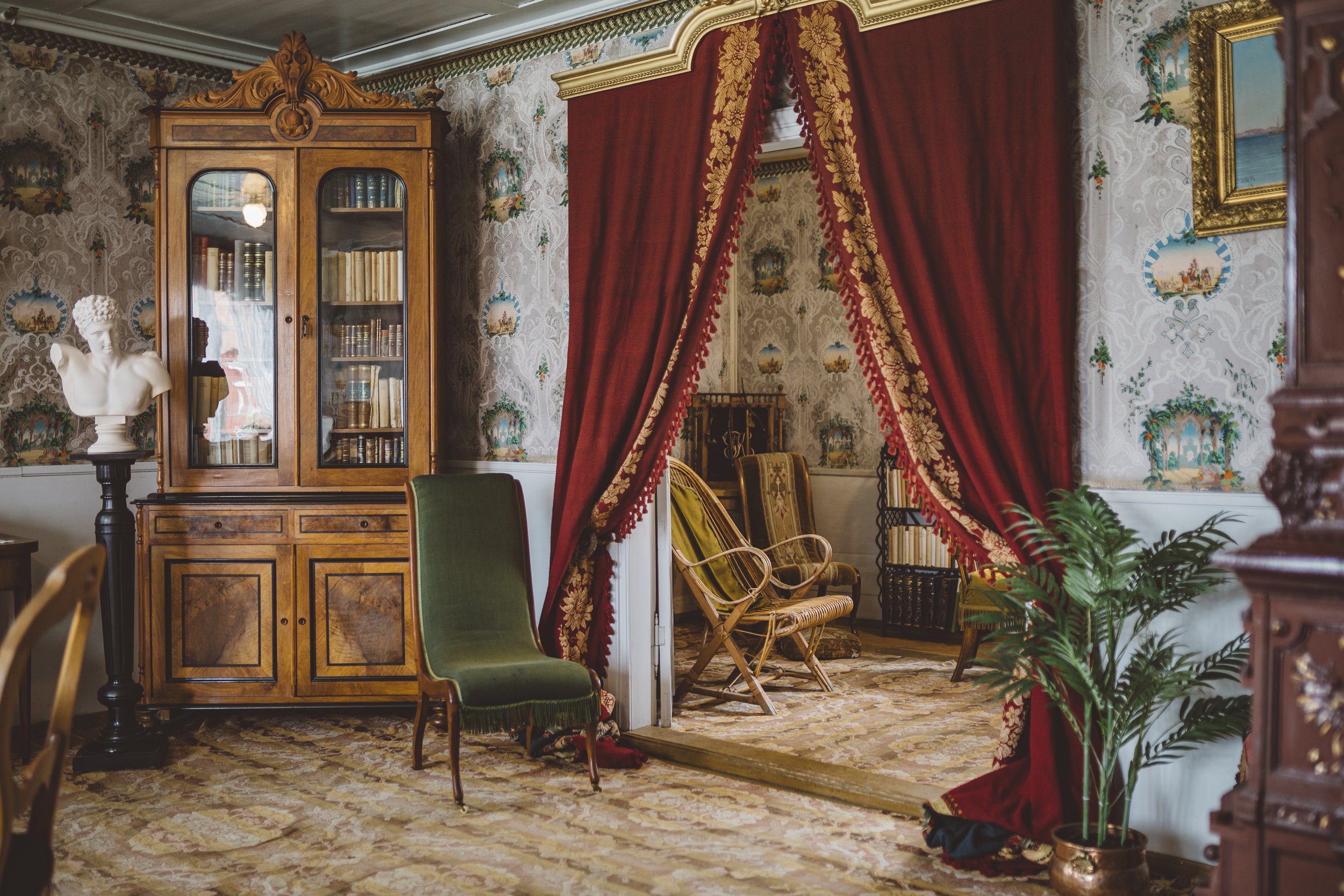
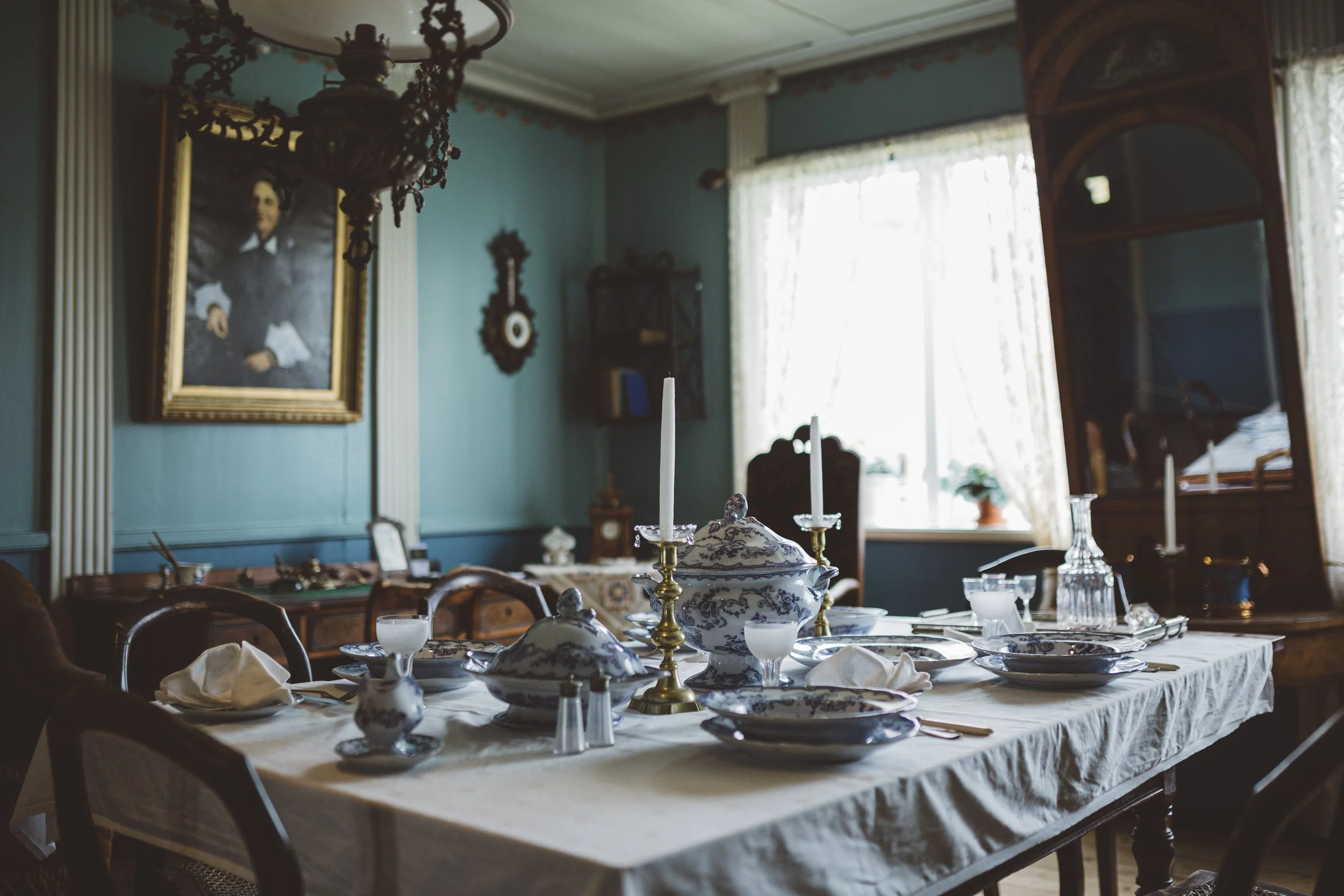
Pictures of the interior of the main house on Kjerringøy trading post Photo: Karoline OA Pettersen
Objects that put a face to history
Then Kjerringøy trading post became a museum in 1959, it was sold along with its contents and archives. Objects and buildings date from the late 18th century until the sale in the mid-20th century.
In 2023, received Nordlandsmuseet a gift from the heirs of Benedicte Dahl, who had passed away suddenly. Benedicte was a descendant of Anna Elisabeth's sister Johanna, and had been in contact with the museum for years about objects and archives from the family.
Among the objects was something the museum had never seen before: a miniature portrait of Christen Sverdrup made during his lifetime. We knew a medallion with a portrait of Jens Nikolai Ellingsen, also made during his lifetime, existed and were meant to receive it.
The donation also included a tea strainer with the initials of Anna Elisabeth and Jens Nikolai, a 19th-century Arkhangelsk box, pewter dishes, tureens, and a corner cabinet.
The miniature portraits put faces on two of the most important men in the history of Kjerringøy trading post, and bring us closer to the people behind this unique cultural heritage.
